
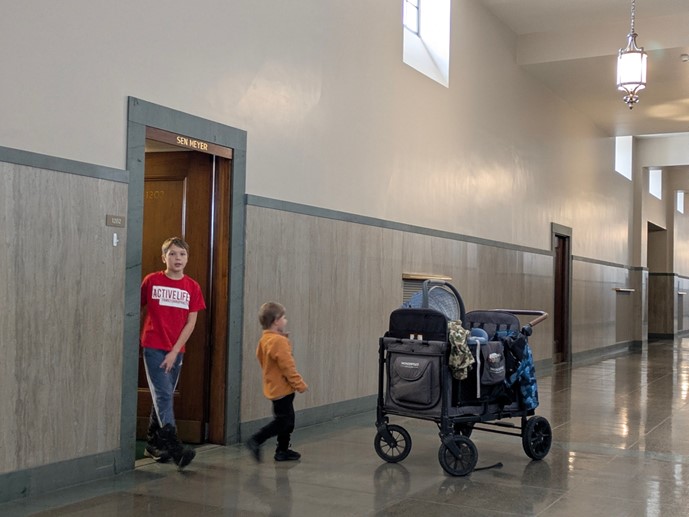
Pictured: Shannon Hampson’s children and childcare kids helped advocate for LB304 at the Nebraska State Capitol Building on December 4, 2025.
Photo credit: Brittany Wren, Stingray Writing
By Brittany Wren, Stingray Writing
In the marble halls of the Nebraska State Capitol, the distance between policy and people can sometimes feel vast. But on a cold December Tuesday, that gap disappeared — bridged by a wagon, a group of dedicated childcare providers, and the innocent curiosity of children.
“Who sits at all those desks?”
The question came from a young child on a childcare field trip, peering through the glass doors of the legislative chamber and pointing down at the senators’ seats.
For Shannon Hampson, a member of the Lincoln Early Childhood Network (LECN) and Owner of home-based Wild Child Daycare, that innocent question sparked a profound realization: those desks belong to the people.
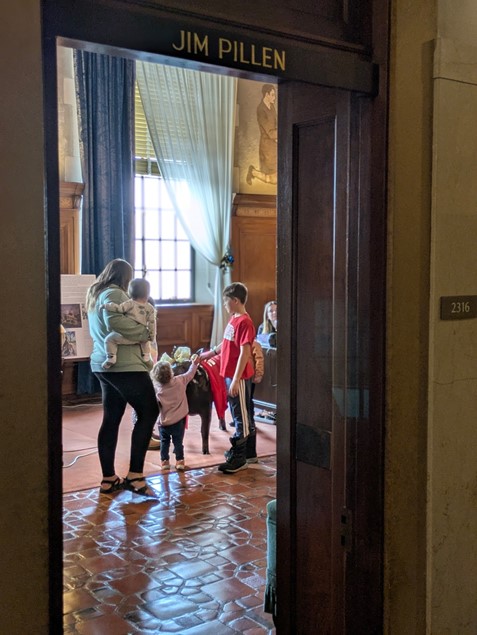
Pictured: Shannon Hampson, her children, and childcare kids advocated for LB304 in Governor Jim Pillen’s office on December 4, 2025.
Photo credit: Brittany Wren, Stingray Writing
Now Shannon regularly takes her children and childcare kids to the Capitol building. It’s not just for field trips. It’s to advocate for the families and children she serves.
The “Business” of Caring
While one arm of the LECN — the “Support for Families” workgroup — was at the Capitol fighting for the resources to keep childcare affordable, another arm was hard at work, ensuring those resources translate into sustainable, high-quality care.
Led by Prudence Devney of the Malone Center and Travis Manley, president of Foundations Nebraska, the Access to Quality Care and Education (AQCE) workgroup operates on a different, equally critical front.
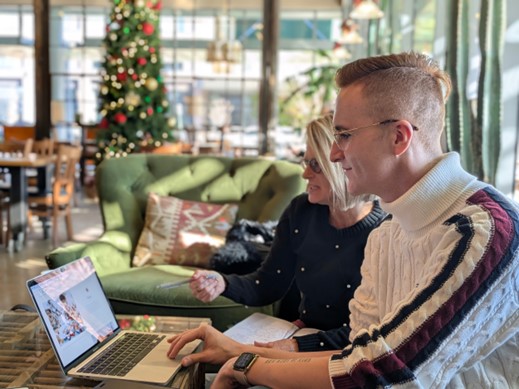
Pictured: Prudence Devney and Travis Manley discussed LECN’s Access to Quality Care and Education workgroup at The Mill on Transformation Drive on December 16, 2025.
Photo credit: Brittany Wren, Stingray Writing
“Most business people in [the childcare] field… are educators with a dream,” explained Travis. “They are not necessarily people who went to an MBA program.”
This reality creates a unique vulnerability. Passionate teachers often jump into the industry to care for children but later find themselves overwhelmed by the operational demands. When the business side struggles, quality can slip. And that’s why LECN exists; the network was developed as a result of the first iteration of Prosper Lincoln, and their focus on early childhood education.
Suzanne Schneider, Associate Director of Lincoln Littles, noted that this workgroup is vital because it moves beyond quick fixes. “They really think about things from a system level,” Suzanne said. “They are using practical experiences to design solutions that are really going to make a difference.”

Pictured: Travis Manley demonstrated a sliding-scale tuition application that his workgroup is developing for LECN, shown at The Mill on Transformation Drive on December 16, 2025.
Photo credit: Brittany Wren, Stingray Writing
Travis and Prudence’s workgroup steps in to fill that gap, developing system-level supports — like sliding-fee calculators and bookkeeping tools — that enable providers to streamline operations and focus on children.
This support extends to physical infrastructure, too. When a developer considered turning the former church on 33rd and Holdrege into apartments and a childcare facility, Travis walked the halls with him. He helped the owner visualize a dual-purpose space. Today, that building houses both residents and Eden Child Care Center — a community asset saved because the network connected the right expert to the right problem.

Pictured: Suzanne Schneider (left) and Michaela Pfeiffer (right) of Lincoln Littles hosted a holiday luncheon for the LECN workgroup volunteers on December 10, 2025.
Photo credit: Brittany Wren, Stingray Writing
Beyond the Check-Up: Connecting Health to Home
If the network’s AQCE group builds the infrastructure, Janel Binder of the Lincoln-Lancaster County Health Department and Kelly Braswell, Executive Director of the Lancaster County Medical Society, ensure the children inside are healthy enough to learn.
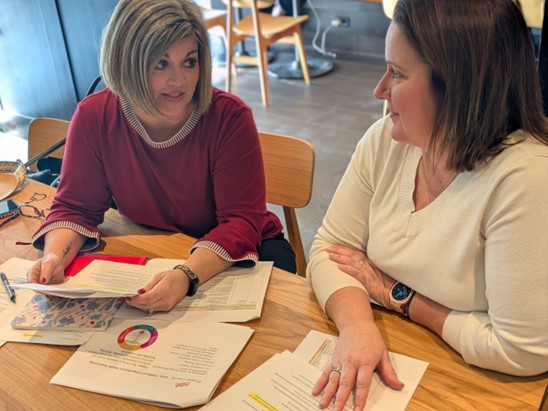
Pictured: Janel Binder (left) and Kelly Braswell (right) discussed LECN’s Comprehensive Health workgroup at Starbucks on 33rd and O Streets on December 17, 2025.
Photo credit: Brittany Wren, Stingray Writing
Co-leading the Comprehensive Health workgroup, Janel and Kelly are tackling a persistent problem: the “silos” that separate public health from private practice.
“In a lot of places, the health department sits by itself, and the medical community sits by itself,” explained Kelly. “They don’t naturally work together for the community.”
Kelly knows the danger of those silos firsthand. A former nurse, she recalls a mother who used to call her clinic’s triage line constantly — not because of medical emergencies, but because she was overwhelmed by parenting and lacked support. “My doctors didn’t know [home visiting] was a service out there,” Kelly admitted.
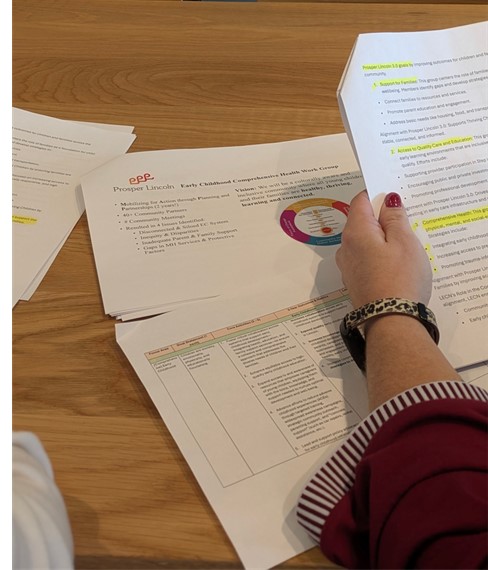
Pictured: Janel Binder shared the mission and vision of LECN’s Comprehensive Health workgroup at Starbucks on 33rd and O Streets on December 17, 2025.
Photo credit: Brittany Wren, Stingray Writing
Now the network ensures those connections happen before a crisis. Rooted in the city’s Community Health Improvement Plan (CHIP), the workgroup acts as a rapid response team for the well-being of the city’s youngest residents. Their goal is to ensure every child has a medical home — a consistent doctor who knows their history — rather than relying on emergency rooms for care.
But their work goes beyond the clinic. The group serves as a critical information pipeline between doctors and childcare providers. For instance, when lead-poisoning prevention resources became available — such as a program to replace old faucets in home-based childcare centers — the workgroup mobilized to ensure the information didn’t get lost in an inbox but actually reached the providers who could use it to keep children safe.
They also tackle persistent systemic gaps, such as the chronic shortage of dentists accepting Medicaid. By monitoring these trends together, the group works to ensure that a solvable problem, like a toothache or a missed immunization, doesn’t become a permanent roadblock to a child’s ability to learn.
Support for Families: Meeting Parents Where They Are
The first two workgroups are the infrastructure and the safety net. The third group — Support for Families — is the front door, supporting early childhood parenting. Co-led by Raegan Brown of CEDARS and Mary Monahan of Macaroni Kid Lincoln, this group acts as both a megaphone in the Capitol and a connector in the community.
On the advocacy front, members of this team organized a critical trip to the Capitol to support LB304, a bill aimed at preventing a subsidy cliff.

Pictured: Suzanne Schneider (left) and Raegan Brown (right) advocated for LB304 at the State Capitol Building on December 4, 2025.
Photo credit: Brittany Wren, Stingray Writing
Without this legislation, the income eligibility for receiving state childcare subsidies would drop from 185% of the federal poverty level (annual income of $59K for a family of four) back to 130% (annual income of $42K for a family of four). Shannon Hampson argued that this cut would force many parents to make an impossible choice: quit school or work, or lose their childcare assistance entirely.
But while they fight for resources at the Capitol, the group also addresses a simpler, daily need: Parents often don’t know what Lincoln has to offer.
“I was pregnant… and realizing that there’s not a lot of good activities out there for working moms,” Raegan explains. “I wanted a place where we could connect all caregivers to things like this.”
To bridge that gap, the group launched its flagship effort: the Early Childhood Family Fair, held annually at Gateway Mall. It’s a massive undertaking that brings over 40 diverse organizations — from the Children’s Museum to the Bike Kitchen — directly to families.
The event is designed to be accessible and engaging for everyone. Every booth must have an activity for kids, ensuring that while children are playing, parents are having meaningful conversations with resource providers.
A Community That Shows Up
From the legislative floor to the busy corridors of Gateway Mall, the Lincoln Early Childhood Network is proving that Prosper Lincoln’s vision is more than a slogan.
But this level of coordination doesn’t happen in isolation. While the network is driven by early childhood providers and supporters who volunteer their time, it is powered by Lincoln Littles. As the convening organization, Lincoln Littles provides the strategic backbone, administrative support, and funding that allows these diverse professionals to stop working in silos and start working together.
“They’re just an amazing collaborative group of professionals that all bring so much knowledge and expertise to the table,” said Suzanne.
Whether it is explaining subsidy cliffs to a Senator, designing a sliding-fee calculator, or ensuring a working mom finds speech therapy for her son, this collective is answering that child’s question at the Capitol.
Who sits in those desks? We all do.
And in Lincoln, through the coordination of Lincoln Littles, we are working together to ensure every child has the support they need to one day take their own seat at the table.
The Lincoln Early Childhood Network (LECN) is convened by Lincoln Littles and is a direct outcome of Prosper Lincoln 1.0’s initiative to ensure that children are socially, emotionally, physically, and educationally flourishing. The LECN workgroups were founded by Michelle Suarez and are open to the public. Visit lecn.org to learn more and participate.